Lessons Under Load: The 2026 Army Best Medic Competition
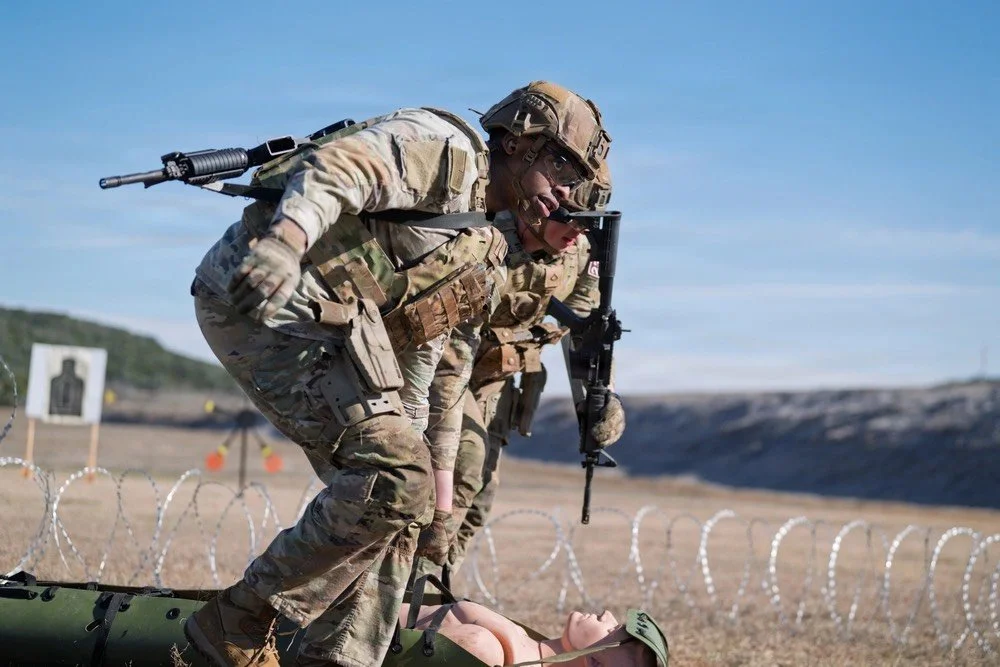
1LT Hinton and PFC Shapley during 2026 Army Best Medic Competition Stress Shoot
Introduction and Competition Overview
We stepped onto frozen obstacle course platforms in sub-25°F temperatures, conditions I did not expect in San Antonio, Texas, only hours into the 72-hour Army Best Medic Competition. After completing a timed written test covering material from the Expert Field Medical Badge (EFMB), mission planning, and general soldiering skills, it became clear that the environment would be as decisive as any medical or tactical task.
The CSM Jack L. Clark Best Medic Competition, commonly known as the Army Best Medic Competition (ABMC), is a multi-day, two-person team event that evaluates medical personnel on physical endurance, tactical competence, and the ability to deliver lifesaving care under sustained stress. Teams across the army earn entry through command level competitions, making participation itself a level of proficiency. Designed to replicate the physical and cognitive demands of combat medical care, the competition challenges participants in conditions where fatigue, uncertainty, and environmental stressors directly influence performance.
First held in 1994 at Fort McClellan, Alabama, the competition was initially referred to as “Super EFMB,’ reflecting emphasis on sustained performance beyond the standard Expert Field Medical Badge requirements. Today, the event honors CSM Jack L. Clark, a respected leader in Army Medicine whose legacy emphasizes the critical role medics play in combat and the care of soldiers.
The Army Best Medic Competition serves as more than a test of individual skill; it validates the highest practical standards for combat medical care under conditions of stress, fatigue, and uncertainty. For medics, it sharpens decision-making and technical proficiency in ways that formal training environments often cannot replicate. For the Army, it exposes capability gaps, stress-tests doctrine, and reinforces a culture that treats medical readiness as a combat multiplier rather than a supporting function.
How the Competition is Conducted
The competition was conducted primarily at Camp Bullis, Texas, where teams were housed in austere field conditions and organized into rotational groups to execute events across multiple training sites. Due to the scale and complexity of the competition, teams completed events in varying sequences, often without visibility on comparative performance. This structure increased uncertainty and placed a premium on adaptability, as teams were required to perform without feedback, benchmarks, or knowledge of standings.
Each evening, cadre issued an operational order outlining the following day’s general conditions while deliberately withholding specific tasks and standards. This ambiguity forced teams to make risk-based decisions regarding equipment, rest, and preparation with incomplete information. In response, competitors routinely shared insights, equipment, and lessons learned, reinforcing a professional culture where collaboration emerged despite the competitive environment.
Prior to the start of the competition, all personal electronic devices were confiscated, and external support from coaches or sponsors was prohibited for the duration of the event. As a result, teams operated in complete isolation for 72 hours, relying solely on pre-competition preparation and the supplies they carried. This constraint amplified cognitive fatigue and reinforced the importance of deliberate planning and self-sufficiency.
Breakdown of Events
The 2026 Army Best Medic Competition consisted of 16 evaluated events conducted over three days. While the specific sequence varied by group, the cumulative design emphasized sustained physical exertion, medical decision-making under fatigue, and adaptability in uncertain conditions. The following summary highlights representative events from the competition.
Day 1
Day 1 focused on establishing baseline performance across academic, physical, and technical domains. Events included a timed written examination covering EFMB material, operational planning, and general soldiering skills; a partner-based obstacle course designed to punish individual weakness through shared physical consequences; and a Combat Water Survival Assessment. Physical fitness was further evaluated through the Expert Physical Fitness Assessment. Teams also completed a Health Service Support planning lane based on a provided operational order and conducted an unassisted M4 zero, which required competitors to rely on personal equipment and prior preparation.
Day 2
Day 2 was the most physically demanding and resulted in the greatest attrition. The day began with an unknown distance ruck march with a minimum 40-pound load, conducted in cold weather and varied terrain. This single event reduced the field from 33 teams to 18 and established physical endurance as the primary determinant of continued participation. Subsequent events included a stress shoot integrating casualty movement, obstacle negotiation, and marksmanship; timed assembly, disassembly, and functions checks of individual and crew-served weapons; and evaluated Tactical Combat Casualty Care and Prolonged Casualty Care lanes. By this point in the competition, teams were operating under significant cumulative fatigue and sleep deprivation.
Day 3
Day 3 tested cognitive performance and technical execution under extreme fatigue. Events included night land navigation, hand and arm signal identification, radio assembly with SALUTE reporting, and a CBRN lane requiring casualty rescue and evacuation in MOPP 4. The competition concluded with a mystery event that integrated various task combat medics are expected to manage in a deployed environment and a ceremonial ruck march that symbolized the end of the competition.
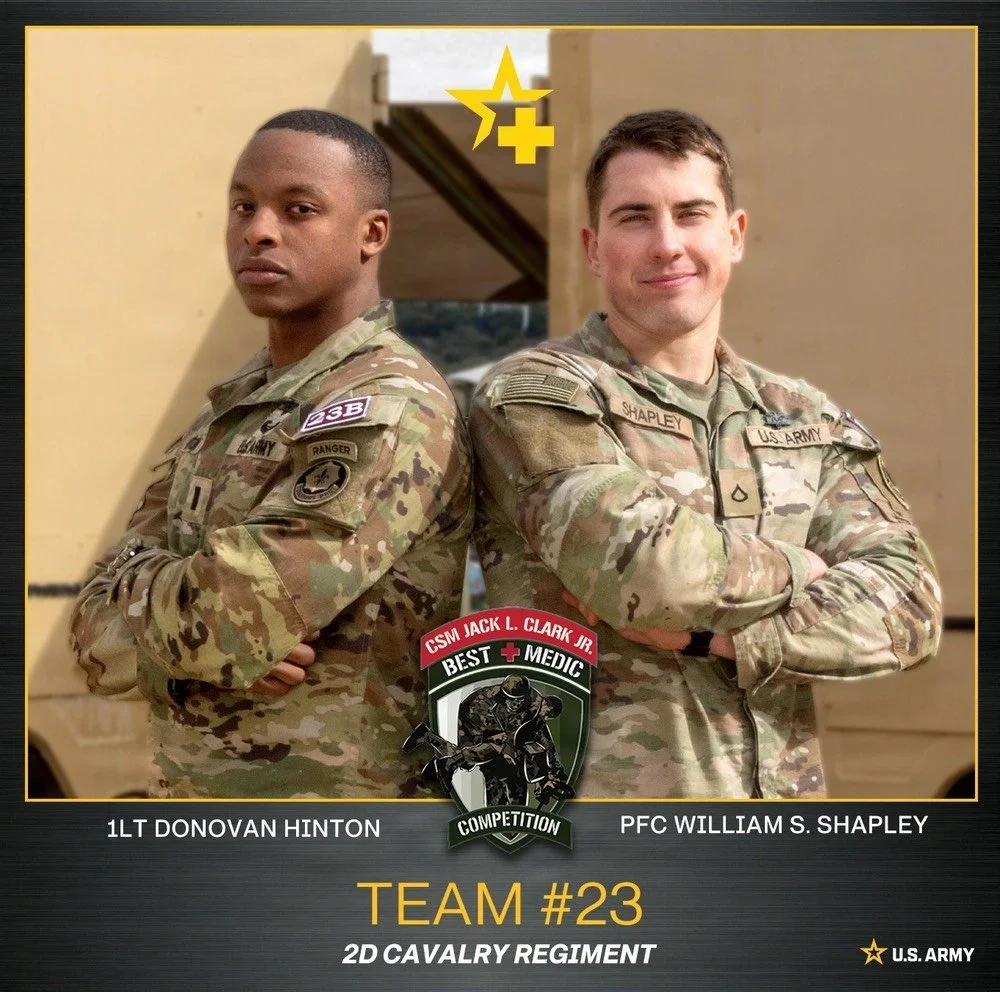
2nd Cavalry Regiment 2026 Best Medic Team Photo
Personal Experience and Performance
While every event presented unique challenges based on the differing strengths of my partner and me, three events most clearly illustrated the demands of the competition: the unknown distance ruck, Prolonged Casualty Care lane, and the mystery event. Each tested a different aspect of performance through physical endurance, clinical decision-making under fatigue, and adaptability in unfamiliar scenarios respectively.
The unknown distance ruck march was the most physically demanding event I have experienced, surpassing similar events I encountered during Ranger School and prior competitions. Conducted in temperatures near 23 degrees Fahrenheit with a minimum 40-pound rucksack, the ruck quickly exposed preparation gaps across the field. Our hydration systems froze within the first 20 minutes, forcing reliance on canteens that later froze as well. Approximately two hours into the movement, I began experiencing severe lower-body cramping that progressively worsened. Recognizing that team completion was essential, we adjusted pace and focused on steady forward movement rather than competition. We completed the ruck in 4 hours and 34 minutes, finishing in the top ten teams. Of the 33 teams that started the event, only 18 remained afterward. As a result, we stopped seeing physical preparation solely as an advantage but as a prerequisite for continuing at all.
The Prolonged Casualty Care (PCC) lane proved particularly challenging due to its complexity and the limited formal PCC training available to many competitors. The scenario involved multiple casualties with competing priorities in an austere environment, requiring continuous reassessment and resource management under fatigue. While we were able to stabilize one casualty through deliberate triage and intervention, other simulated patients deteriorated despite appropriate efforts. The absence of post-event feedback limited opportunities for immediate learning; however, the lane effectively highlighted the importance of PCC and delayed evacuation training as critical, yet underdeveloped, competencies across the force. We hope to never be in a real-life situation is required but accept that is a reality for current reality for the conflicts of today. We hope to never face a real-world situation requiring prolonged casualty care, yet current conflicts make it no longer theoretical. Preparation for PCC is not optional; it is a responsibility we carry whether we feel ready or not.
The mystery event tested adaptability in a way that no prior preparation could fully replicate. The scenario integrated resupply operations, casualty extraction from a vehicle, and Tactical Combat Casualty Care for both a simulated military working dog (MWD) and human casualty. In a previous competition, our team encountered a similar scenario and failed to treat the MWD effectively due to lack of preparation. Learning from that experience, my partner independently studied MWD casualty care beforehand, anticipating that such an event might reappear. When the scenario unfolded, we divided responsibilities based on strengths and executed deliberately under fatigue. His preparation allowed us to provide effective treatment while I focused on documentation and coordination, reinforcing the value of initiative and complementary team roles. More than any single technical skill, the event highlighted how growth often comes from confronting past shortcomings and deliberately preparing to avoid repeating them.
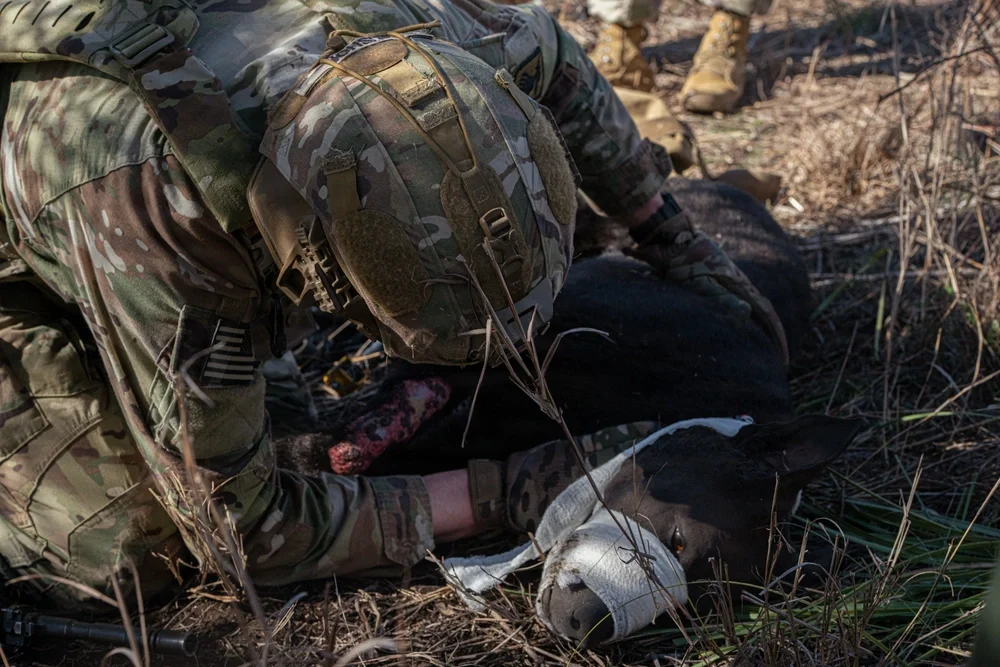
Treatment of a simulated military working dog during mystery event
Lessons Learned
Ultimately, our team placed 4th out of the 33 teams that participated. We honestly did not expect to achieve this, considering we were unable to conduct a proper competition train-up and felt that we lacked the expertise compared to other teams. Regardless of our performance, I took away three major lessons from participating in this competition.
1. Prepare for the Unexpected
Combat medics rarely operate in controlled or predictable environments, and the competition reinforced the reality that success depends on the ability to perform under adverse and rapidly changing conditions. Many events were shaped as much by environmental stressors and fatigue as by technical difficulty. While our team did not always demonstrate the highest level of technical proficiency, physical fitness enabled us to remain effective across events. A medic who lacks physical endurance risks becoming another casualty rather than a solution, particularly in environments that demand prolonged movement, casualty evacuation, and sustained care.
2. Teamwork Is a Force Multiplier
Effective performance depended on the ability of teammates to compensate for each other’s limitations while leveraging individual strengths. As a Medical Service Corps officer paired with a Combat Medic, our success relied on deliberate role clarity and mutual trust. Physical tasks such as litter carries and casualty extractions required shared endurance, while medical and administrative responsibilities were executed based on expertise. This experience reinforced that most military tasks, particularly in combat medicine, cannot be accomplished in isolation and are ultimately enabled by cohesive teams.
3. Competition Matters
High-stakes competitions such as the Army Best Medic Competition drive professional growth by exposing participants to conditions that standard training environments rarely replicate. Regardless of outcome, competitors are forced to confront personal and organizational limitations, refine decision-making under pressure, and operate within a demanding professional culture. For the Army, these competitions serve as laboratories for readiness by identifying capability gaps, reinforcing standards, and developing leaders who are better prepared for the realities of combat operations.
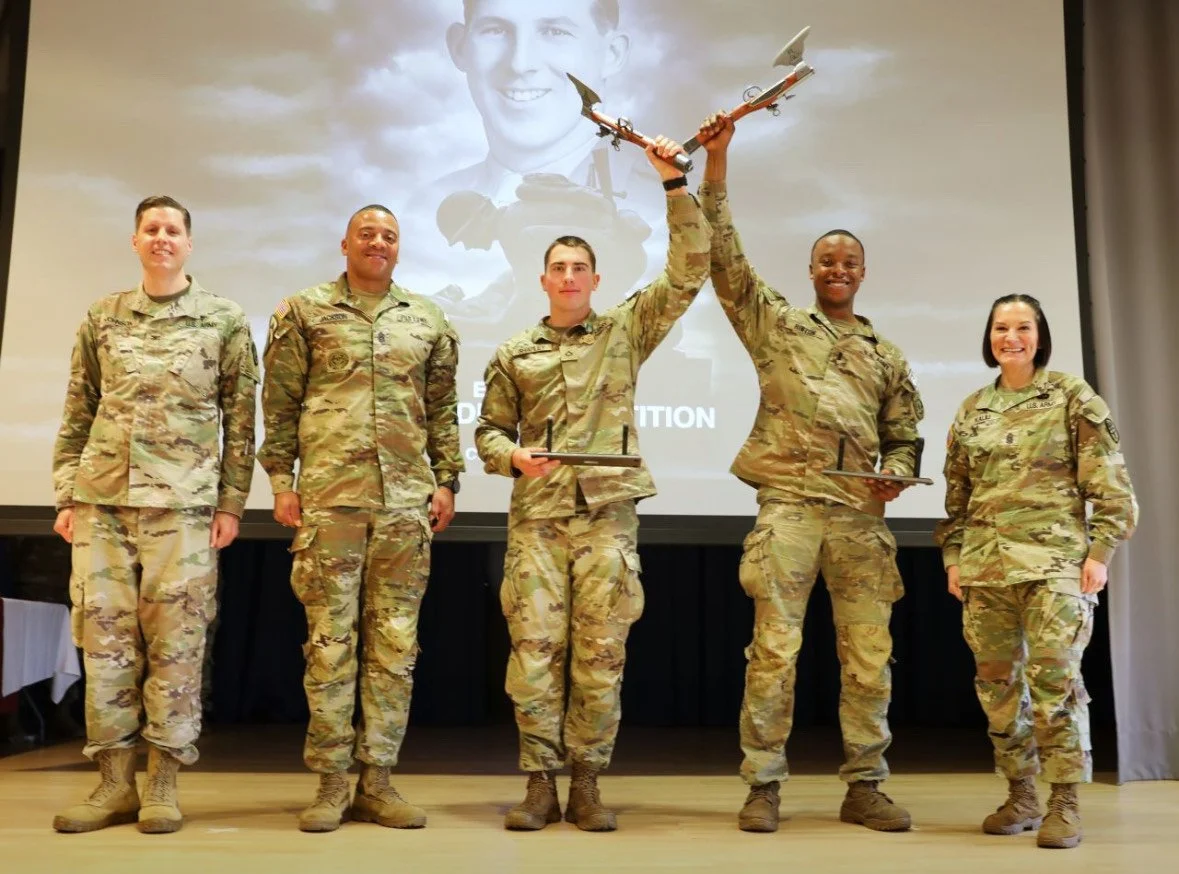
1LT Hinton and PFC Shapley winning the 2025 Medical Readiness Command, Europe Best Medic Competition
Characteristics of Successful Competitors and Preparation Considerations
Observing top-performing teams throughout the competition revealed consistent characteristics that directly influenced success. Foremost among these was physical fitness. Regardless of technical knowledge or experience, competitors who struggled with endurance-based events were unable to remain competitive or, in some cases, complete the event. Mental acuity and medical proficiency diminished rapidly under physical exhaustion, reinforcing that fitness underpins all other competencies in combat medicine.
Technical proficiency and experience in casualty care were also decisive, particularly during Tactical Combat Casualty Care and Prolonged Casualty Care lanes conducted under fatigue. While marksmanship, weapons handling, and land navigation remained important, these skills were only relevant if competitors possessed the physical capacity to execute them after prolonged exertion. In this environment, fitness was not a complementary attribute but a prerequisite.
If preparing for future iterations of the competition, training should deliberately integrate aerobic endurance, muscular endurance, and repeated exposure to medical tasks under fatigue. Preparation should also encompass historically tested events and incorporate hands-on repetitions with individual and crew-served weapons. Where live-fire opportunities are limited, simulation systems such as the Engagement Skills Trainer (EST) can partially mitigate gaps. Most importantly, protected time for preparation is critical; without it, teams must rely on personal initiative rather than deliberate training programs, which limits overall readiness and performance.
Conclusion
Participation in the Army Best Medic Competition provided a demanding and instructive perspective on the realities of combat medical readiness. As a Medical Service Corps officer, the experience deepened my appreciation for the technical skill, physical endurance, and adaptability required of Combat Medics and reinforced the importance of deliberate preparation at the unit level. The competition highlighted how fitness, teamwork, and initiative directly translate to effectiveness in austere and uncertain environments.
Preparation only reveals its true value when tested under conditions we cannot fully control.
—Don in Progress
Best Medic References
- ATP 7-22.01, Holistic Health and Fitness Testing, 1 August 2022.
- ATP 4-02.5, Casualty Care, 10 May 2013.
- ATP 4-02.3 Army Health System Support to Maneuver Forces, 9 June 2014.
- ATP 4-02.2, Medical Evacuation, 11 July 2019.
- ATP 4-02.13, Casualty Evacuation, 30 June 2021.
- ATP 3-90.37, Countering Improvised Explosives Devices, 29 July 2014.
- ATP 3-21.18, Foot Marches, 13 April 2022.
- FM 4-02, Army Health System, 17 November 2020.
- STP 21-24-SMCT, Soldier’s Manual of Common Tasks (SMCT) Warrior Leader Skills 2, 3, and 4, 9 September 2008.
- STP 21-1-SMCT, Soldier’s Manual of Common Tasks, Warrior Skills, Level 1, 16 October 2023.
- TC 8-800, Medical Education and Demonstration of Individual Competence (MEDIC), 15 December 2021.
- STP 8-68W13-SM-TG, Soldier’s Manual and Trainer’s Guide, MOS 68W Healthcare Specialist (Skill Levels 1/2/3), 3 May 2013.
- TC 3-25.26 (FM 3-25.26) Map Reading and Land Navigation, 15 November 2013.
- TC 3-23.35, Pistol, 30 May 2017.
- TC 3-22.9, Rifle and Carbine, 13 May 2016.
- TC 3-20.0, Integrated Weapons Training Strategy (IWTS), 18 June 2019.
- The U.S. Army MCoE PAM 350-10, the Expert Field Medical Badge (EFMB) Test, 14 June 2022.
- SH 21-76 Ranger Handbook, February 2011
The views expressed are those of the author, and do not reflect the official position of the United States Military Academy, Department of the Army, or Department of Defense.
