From Failure to “Top Doc”
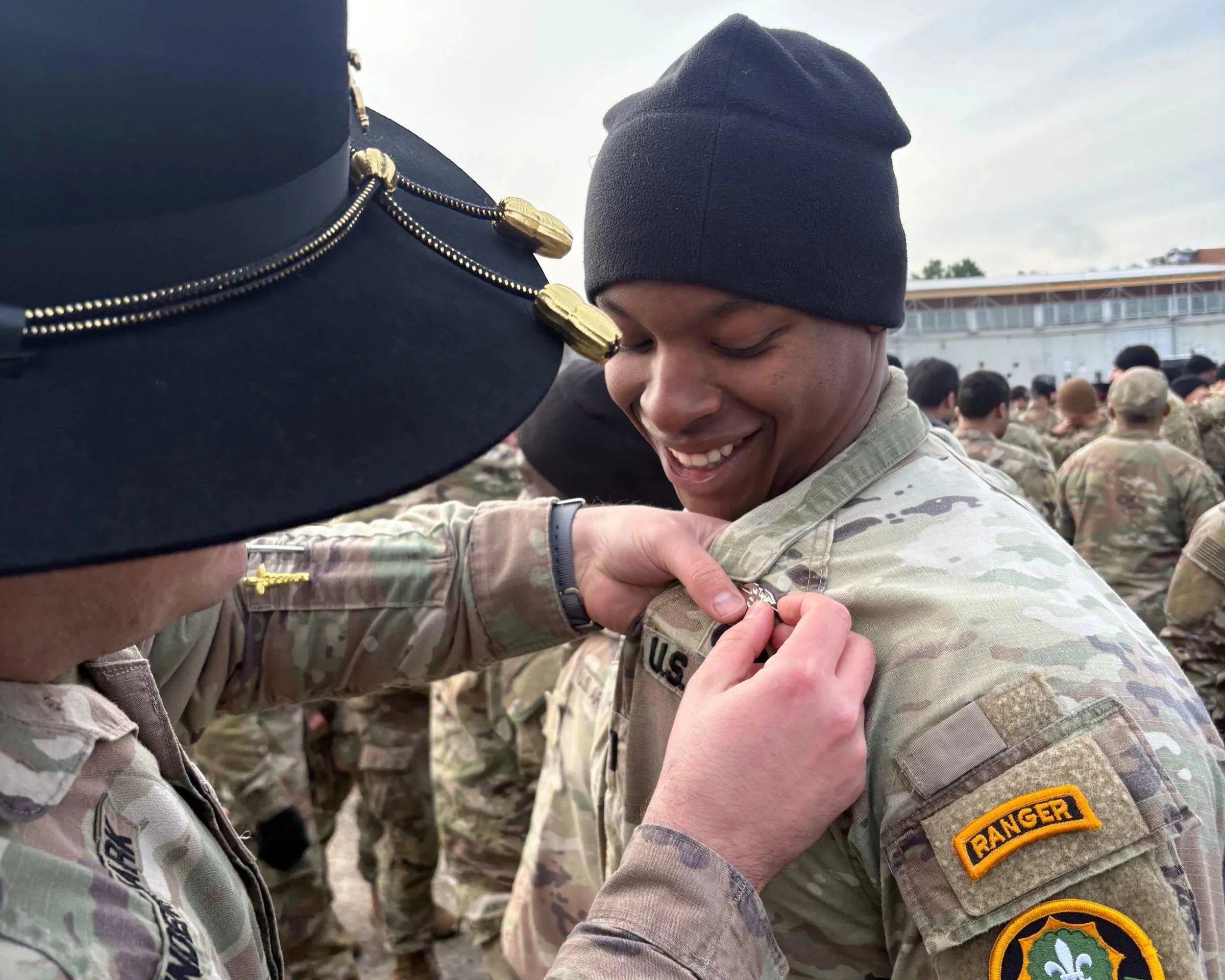
Receiving my Expert Field Medical Badge on Graduation Day.
Failure and Return
In April 2023, I made my first attempt at earning the Expert Field Medical Badge (EFMB) as a junior second lieutenant and failed land navigation on the first day of testing.
In November of 2025, I completed EFMB as the honor graduate “Top Doc” with a 100% GO rate and earned the title of “No Blood.”
I recognize now that the difference between those two attempts had less to do with talent and more to do with how I approached preparation.
EFMB is often associated with being well-rounded, but what stood out to me the most was the level of attention to detail required to succeed. While skill is absolutely necessary, most of the evaluation process rewards procedural precision, repetition, and the ability to execute tasks exactly to standard under pressure. Missing a single step or performing an action out of sequence can result in immediate failure, even if most of the task is completed correctly.
Failing my first attempt forced me to recognize that effort alone was not enough and that I needed a different level of intentionality in order to increase my chances of success.
What EFMB Actually Rewards
Before my second attempt, I spent time trying to better understand what EFMB was truly evaluating. Physical fitness and technical skill were clearly relevant, but I realized that the majority of the assessment depended on procedural precision and attention to detail.
In many cases, completing most of a task correctly was not enough. Missing a small step, performing an action out of sequence, or overlooking a specific procedural requirement could immediately result in a “NO-GO.” Something as simple as failing to tug on a magazine during a weapons functions check or loading casualties into a vehicle in the wrong order could result in lane failure.
To even compete for a slot to obtain the badge, candidates first had to pass a written test, achieve a qualifying Army Fitness Test score, and shoot expert on the M4 or M17. Dedicated days were allotted for train-up and standardization of participating candidates but once testing began, candidates moved through a series of evaluated events that included Evacuation lanes, Warrior Skills lanes, Tactical Combat Casualty Care (TCCC), the Expert Physical Fitness Assessment, Land Navigation, and a twelve-mile ruck march.
While every event required a degree of technical proficiency, memorization played a significant role in what made EFMB challenging. This was evident through the cognitive load required to learn numerous steps and complete varying tasks. The TCCC lane imposed the heaviest cognitive load as a nearly two‑hour task that required multiple sub tasks to be performed to standard. The twelve mile ruck march was generally considered simple since very little mental energy was needed. You either could or could not meet the physical standard.
Accepting these facts was necessary to change how I approached preparation. I came to the realization that success was not simply about understanding certain tasks conceptually. It required repetition to the point where execution became automatic, deliberate, and consistent under stress.
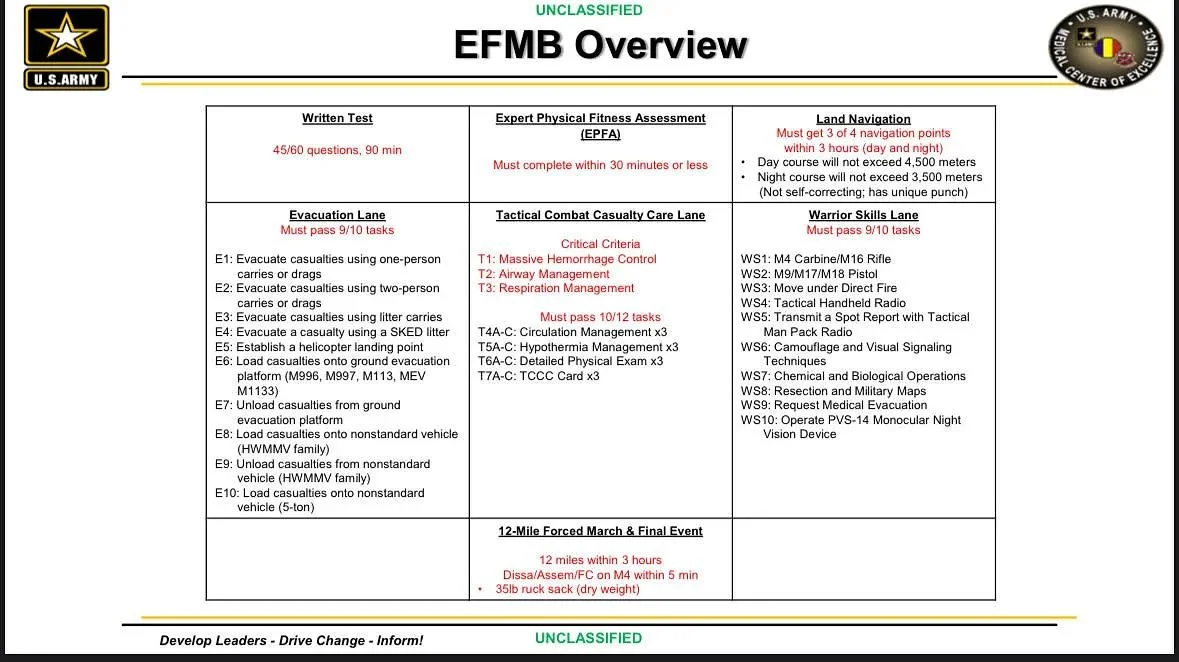
EFMB Overview as of 2026.
Preparation Became Lifestyle
Once I earned the prerequisites required to compete for EFMB, I did not wait for the official train-up period to begin preparing. Failing my first attempt was enough to know that changing my approach to the process was non-negotiable. I knew I could not rely on simply “working hard” when the testing standard demanded precision under pressure.
Preparation gradually became part of my daily routine rather than something limited to scheduled training hours. During my commute to and from work, I would recite the steps of evaluated tasks aloud from memory. I spent time reading the EFMB handbook, watching videos of the lanes, and getting hands-on repetitions with radios, weapons, and medical equipment whenever I had the opportunity.
Land navigation received particular attention because I knew it was a depreciating skill and had previously been the event that ended my first attempt. I practiced plotting points, building route plans, and analyzing terrain at the land navigation courses near my duty station. The more repetitions I accumulated, the more confidence I developed in my ability to perform under test conditions.
Outside of formal instruction, I tried to eliminate as many distractions as possible. I deleted social media applications from my phone, stopped consuming content for entertainment, and intentionally limited my attention to things that directly contributed to preparation. Friends and family knew I would be less available during that period because nearly all of my free time revolved around EFMB. In retrospect, that level of focus was probably one of the most important factors in my performance.
Even rest became intentional. Some nights I stayed at a friend’s house closer to base instead of driving home because it allowed me to sleep longer and remain mentally sharp the next day. I believed that recovery, repetition, and focus were all interconnected.
By the time testing began, I felt prepared, but I also understood that preparation could not become complacency. Attention to detail still mattered every day.
Attention to Detail and Humility
Through my preparation I realized that understanding tasks generally was only part of the process. The more important challenge was learning to execute each task exactly how the graders expected to see it performed.
Small details often determined success or failure. Certain radios required slightly different programming sequences and a weapons functions check could be wrong if a specific action was omitted, even when the rest of the sequence was completed correctly. These nuances reinforced that EFMB was not simply evaluating effort, but disciplined attention to detail.
Because of similar notions, I remained highly attentive during every block of instruction. I took notes consistently and asked questions whenever I was uncertain about a step or procedure. I also never approached the process as though I already knew better than the instructors or cadre. In many cases, the smallest clarification could prevent failure later during testing.
Along with my efforts, I learned quickly that I could not prepare effectively alone. Since I was a medical operations officer and not a combat medic, there were aspects of patient treatment and medical procedures that were unfamiliar to me. The medics around me had significantly more experience in those areas, and I relied heavily on their guidance to improve my own performance. Whether it was a more efficient way to apply a splint, manipulate equipment, or organize treatment steps, I tried to absorb as much as possible from people who understood the tasks better than I did.
I realized that preparation was not just about repetition but humility as well. There was no use repeating the same tasks incorrectly so being willing to learn, adjust, and refine small details continuously without allowing ego to interfere with improvement was key to decreasing the learning curve.
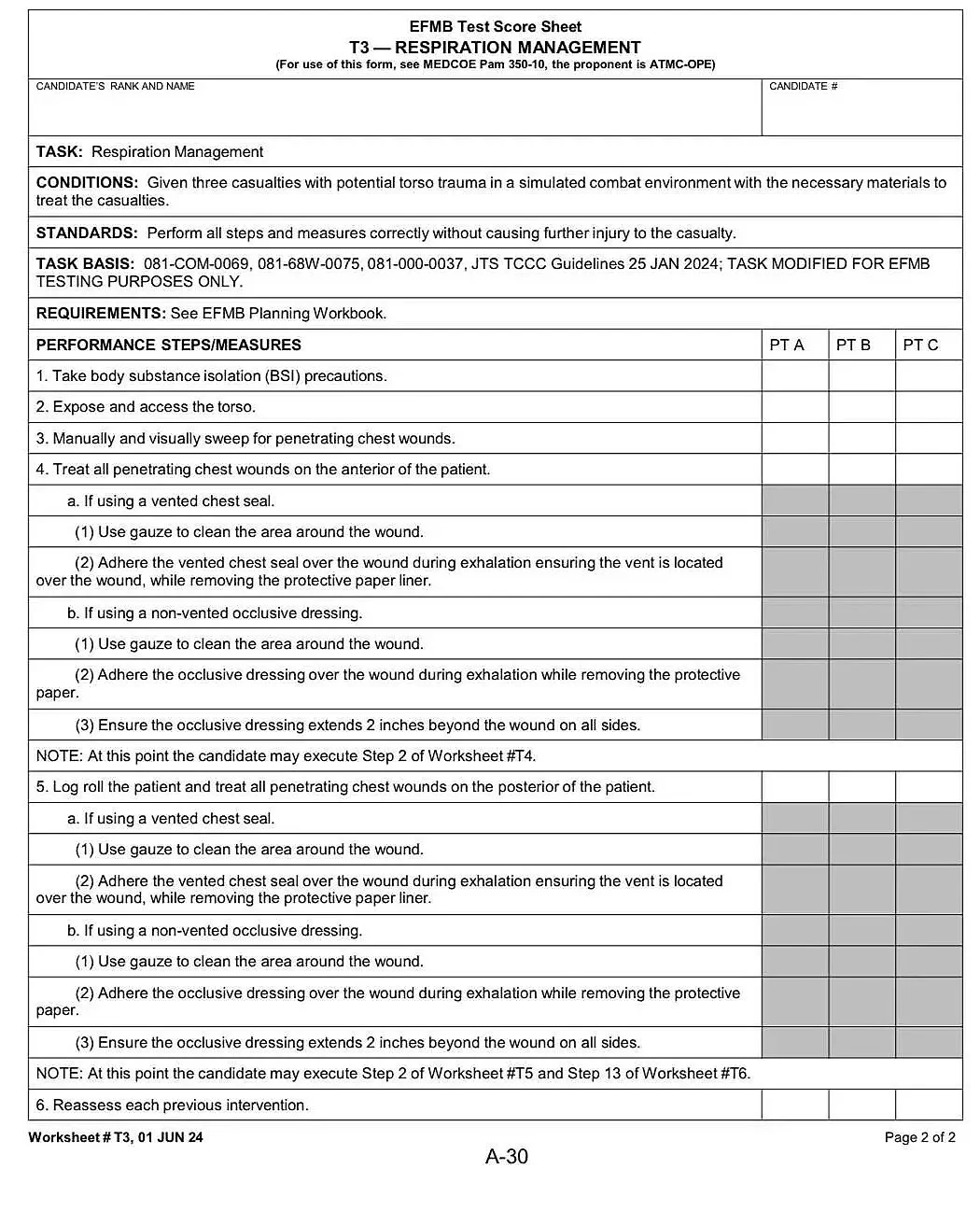
Portion of TCCC Lane testing standards from EFMB Handbook.
The TCCC Lane
Of all the evaluated events, the Tactical Combat Casualty Care Lane was objectively the most demanding for me. Candidates were allotted one hour and forty-five minutes to manage three notional casualties with very little room for error. The lane required sustained focus, procedural accuracy, and the ability to think clearly while moving continuously between multiple problems.
I understood early that the only way I would feel confident during testing was through repetition that closely replicated test-like conditions. To practice, I placed pieces of paper around my living room representing casualties with different injuries and rehearsed moving between them repeatedly while “providing care” in a manner similar to shadowboxing. Since I did not have access to an M4 at home, I used a broomstick to simulate maintaining accountability of my weapon throughout the lane because loosing proximity to it during testing would result in a “NO-GO.”
Looking back, I probably looked ridiculous moving through my house with a broomstick while verbally walking through casualty treatments, but I understood why I was doing it. I sought to reduce uncertainty through repetition and build habits that would remain consistent under stress.
Those rehearsals became part of my daily routine. If time allowed, I would practice the lane before going to bed and again in the morning before scheduled training. Some people viewed that level of preparation as excessive, but I did not care about how it appeared externally. I cared about minimizing the possibility of failure.
I learned that confidence was not something I could create artificially. While I was familiar with the saying “face it to you make it”, that idea could not be applied to this situation, and I felt truly confident when I had evidence to justify confidence. That proof was built through accumulated repetitions that allowed execution to feel increasingly automatic.
“Top Doc”
We began EFMB testing with over one hundred candidates, but only twenty-eight ultimately earned the badge. Of those twenty-eight, only five completed every evaluated event without receiving a single NO-GO, earning the designation “No Blood.” The candidate with the fastest twelve-mile ruck march among that group was recognized as the honor graduate, “Top Doc.”
By the time testing began, I believed I had prepared myself as thoroughly as possible. Writing this now, I recognize that some of my mindset during that period may sound overly confident, but mentally I felt certain that I had done everything within my control to succeed. Through my preparation, repetitions, and interactions with other candidates, I understood how well I committed myself to the process.
I will admit that I was obsessed but not with being number one. I was obsessed with demonstrating the best I was capable of. In this case, it happened to result in me earning the honor graduate distinction.
Reflecting on it all, the recognition itself mattered less than what it represented. The outcome reinforced something I had already begun to understand long before testing started; confidence is built through preparation that is honest, consistent, and difficult to compromise internally.
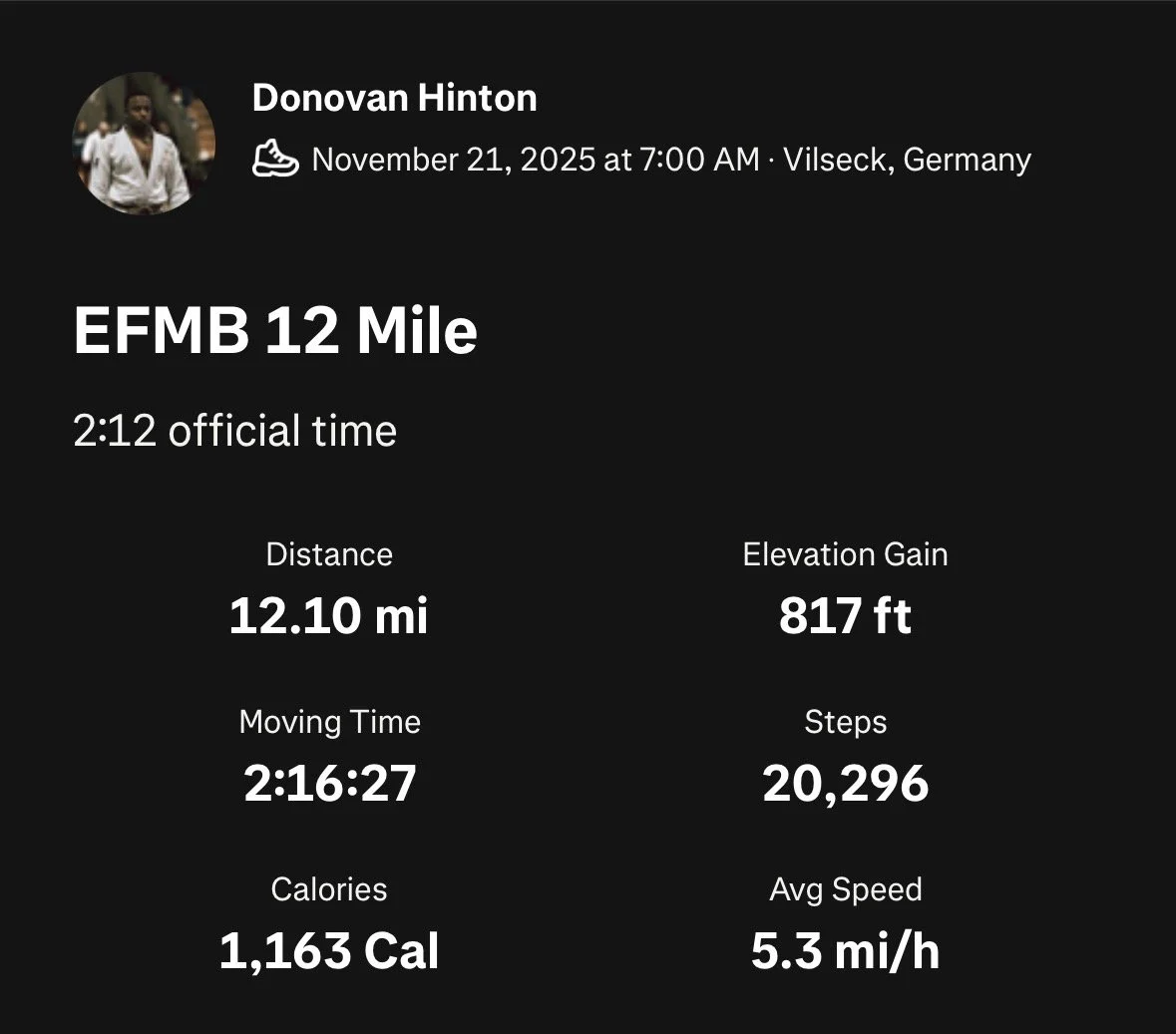
EFMB 12-Mile Ruck March workout summary.
What I Learned
EFMB reinforced something I had already started to understand through other experiences: meaningful performance requires an unusual degree of intentionality.
Success in environments built around attention to detail cannot rely solely on motivation or talent. It requires sustained focus, repetition, and the willingness to structure your environment in ways that support the objective you are pursuing. In my case, that meant eliminating distractions, narrowing my attention, and dedicating most of my free time toward preparation.
I also came to appreciate the difference between productive rest and passive distraction. Sleep, recovery, and quiet time helped me remain mentally sharp, while excessive stimulation through social media or entertainment often made sustained focus more difficult. Over time, I became more aware of how strongly environment influences attention and performance.
At the same time, the experience reinforced that preparation is rarely an individual process. Guidance from instructors, support from peers, and learning from people with greater technical expertise all accelerated my development. Effort mattered, but humility mattered too.
EFMB ultimately taught me that confidence is not built through self-belief alone. It is built through preparation that becomes difficult to question internally because the repetitions, discipline, and attention invested makes it hard to.
